Orientation and Mobility Training for different ages
Whatever your age—and whether you’ve experienced low vision or blindness your entire life, or recently had a change in vision—Orientation and Mobility (O&M) training can support you with valuable skills to improve your independence.
All Orientation and Mobility Training programs are uniquely tailored to your personal needs, goals, situation, and preferences.
With that said, there are some common ways that the training can be adapted to meet the requirements of people at different ages. That includes:
Children.
Teenagers.
Adults.
Older people.
In this article, we’ll describe some of the common skills you can learn in Orientation and Mobility Training, and provide some examples of how training can be modified to meet the needs of people at different stages of life.
Orientation and Mobility training for young children and teenagers.
Orientation and Mobility training for children—which is also commonly called Children’s Mobility training—can adapt to support your child throughout their entire school life, from kindergarten and pre-school through to Year 12 and early adulthood. For children younger than school age, there is a separate support program called Early Childhood Vision Services.
Children’s Mobility training supports young people and children to move through the world with confidence. We know that kids can grow and change quickly, so Children’s Mobility training progressively evolves alongside your child’s needs by introducing different skills and mobility aids as they become relevant in daily life.
Training is usually offered with a specialised Orientation and Mobility instructor. Training sessions complete in a one-on-one format, wherever your child is most comfortable. That might change depending on your child’s goals, but we commonly deliver training:
In your home.
At school.
Out and about in the community.
It’s all about supporting your child to safely explore the world and navigate their daily routine with greater independence.
What kinds of skills can my child learn in Children’s Orientation and Mobility training?
There are many, many different skills that children learn in training. Again, it depends on your child’s personal situation and unique goals. Some common skills include:
Understanding their place in the world: this can be taught using games and concepts that are already known to your child, like learning spatial concepts by building familiar environments with Lego blocks. The training can also cover using different senses for environmental cues, like the sound of traffic, the smell of a local restaurant on the way home from school, or tactile signals like the texture of the ground changing.
Learning how to play and move safely: this can include a range of skills at different ages, from learning how to run, jump and skip in younger years to developing cane skills and understanding assistive technologies later on.
Preparing for teenage years: this includes traffic concepts, road safety, and how to independently use public transport to get to school or catch up with friends.
How is the training uniquely tailored for children and young people?
Early intervention: It can be beneficial to start children’s O&M training as early as possible. This encourages children to develop core foundational skills for independence and mobility as they grow.
A multi-sensory approach to learning: combining different teaching approaches, based on sound and movement for example, supports children to understand and retain information more effectively.
Structured, progressive learning activities: we break down O&M skills and concepts into manageable activities that are appropriate for your child’s age, goals, and development level. By progressively introducing more complex tasks over time, your child can master skills at whatever pace is most comfortable for them.
A focus on fun: teaching valuable skills through play and exploration helps to make learning more enjoyable and meaningful for your child. This can include training through scavenger hunts, games that your child may be familiar with, and sensory activities that make it fun to learn navigation skills.
Positive reinforcement: celebrating success is an important part of building confidence and keeping energy levels high. Every little milestone counts in keeping your child engaged and motivated to keep training.
A supportive role for friends and family: O&M specialists can provide families with resources and guidance to ensure that training continues outside of your child’s schedules sessions. This helps to ensure that O&M skills are an ongoing practical part of daily life, at home, kinder, or school.
Orientation and Mobility training for adults and older people.
Training can be valuable for anyone, at any age or stage of life. Even if you have lived with low vision or blindness for a long time, it can be helpful to refresh your skills or learn new mobility techniques to find your way through the world with confidence. Additionally, we can always provide support if you’ve completed an O&M training program and your goals have changed,
Many aspects of Orientation and Mobility training for adults and older people are flexible based on your wants or needs. For example, training can range from one single session to several weeks of intensive classes. The location of your training will also depend on the specific types of skills you’d like to learn.
What kind of skills can I learn in Orientation and Mobility training?
There’s always something new and useful you can learn in O&M training. We personalise each training program based on your unique goals.
Some of the specific skills you can learn include things like:
Planning a route: with techniques to map a safe, efficient path between multiple destinations, while managing any hazards or obstacles that pop up along the way.
Using public transport: learn to catch the local bus, tram, train, or ferry safely, with skills to read transit maps and schedules or ask for assistance if you need it.
Learning to use assistive technologies and new devices: there are many modern devices and technologies that can make life easier for older people, including GPS navigation systems, smartphone apps, and other tools. We can support you to learn new technologies and be comfortable using whatever device you need or prefer to support your independence.
Crossing streets: build your confidence in the community by learning to safely cross streets and navigate intersections. This can include skills to assess different traffic flows, find traffic lights and pedestrian crossings quickly, and make safer decisions based on a range of sensory cues.
Keep doing the things you love: like catching up with friends, going to your local community centre or water aerobics class, going out for dinner with family and grandchildren, and much more.
How is the training uniquely tailored for older people?
O&M training can be adapted for older people to accommodate considerations that relate to age-based changes in physical ability, cognition, and sensory functions.
Some of the ways that Orientation and Mobility training can be adapted for older people include:
An initial assessment of your abilities and preferences: the best approach for your training might change depending on your level of vision, hearing, physical strength, balance, and cognitive skills. An early catch up to check in on your personal situation ensures training is tailored exactly to your needs.
A more relaxed pace of learning: training can be modified to allow more time for you to learn new concepts, develop skills at the pace you prefer, and build confidence.
Focusing on sensory techniques: training can be tailored to maximise the use of your strongest senses, through skills based on touch, hearing, smell, and even ‘proprioception’—your body’s ability to sense movement and action in the environment around you.
Wrap-around emotional support: encouragement and positive support can be important for older people experiencing O&M training, as it can be frustrating or nerve-wracking learning new skills.
Collaboration with other healthcare specialists: as we age, it becomes more likely that people will experience multiple health conditions that may impact orientation and mobility. By working with other health professionals, including ophthalmologists, occupational therapists, and more, we can address any unique concerns or challenges that may impact your O&M skills development.
Want more information about Orientation and Mobility training at different ages?
Whether you’re looking for details for yourself, a loved one, or you’re a medical professional hoping to make a referral, you’ll find more information on the right service for you below:
Comparing Orientation and Mobility for young children versus teenagers
Through safe play and by exploring new environments with confidence, we learn about ourselves, each other, and how to be part of a community.
Children with low vision or blindness are no different. However, they need to develop a different set of skills to understand and move through the world. These skills are taught in Children’s Mobility training.
In this article we’ll look at some of the valuable techniques a child can learn during this training. We’ll also consider how the training changes and can be built upon as the recipient moves into their teenage years.
Keep in mind that this is not an exhaustive list of every possible kind of training provided to children and teenagers. The right training for you or your child will depend on their specific needs and circumstances.
Orientation and Mobility for young children
Mobility training helps a child build on their personal goals as they transition from home to kinder to school. It can include skills to make new friends and interact with other people in their community.
More specifically, it can include:
Developing foundational orientation and mobility skills through play. That training can involve people and games that are already part of the child’s life, for example:
Learning spatial and environmental concepts by using Lego to build a map of a street block.
Understanding how to use senses like hearing for interpreting an environment – the sound of a truck versus the sound of a lawn mower or the smell of a bakery, for instance.
Developing skills in using a mobility aid such as a long cane or wheelchair to move safely through space.
Learning to confidently explore and travel around the home, kinder, school, and outdoor environments.
Learning to play safely by moving more self-assuredly and developing techniques for increased awareness of the world.
Preparing for teenage years by beginning to get an understanding of road and traffic concepts, and independently travelling to and from school.
Children’s Mobility training teaches your child valuable practical skills while encouraging them to make friends, be creative, and explore their potential. Importantly all Children’s Mobility training offered by Guide Dogs is delivered with a focus on fun.
Support is usually provided one-one-one in an environment where your child is most comfortable; that location will also usually depend on their goals. It could be in your home, at school, or out and about in the general community.
Guide Dogs offers Children’s Mobility training as part of individual programs, camps, group programs, and workshops.
Orientation and Mobility for teenagers
Orientation and Mobility training for teenagers differs from the training mentioned above, which is specific to children under the age of 13.
Teenagers tend to be eager to have more responsibility and set their own goals; they also often like to develop plans for achieving those goals. An Orientation and Mobility Specialist will support a teenager by building on the foundational skills learnt as a child.
Training specific to teenagers includes:
Safe travelling skills, including skills that help a young person with low vision or blindness to move through the community, catch public transport, respond to fellow pedestrians and commuters, as well as use of mobility aids such as long canes to travel with confidence.
More complex skills than for a young child. Training for teenagers is, naturally, more advanced than it is for children, aiming to achieve an age-appropriate level of independent travel within the community. That includes more involved tasks, such as route planning, using technology, and navigating busy streets and intersections.
Different social factors. Teenagers want to connect with their peers, make new friendships, and may be more self-conscious than a younger child about using mobility aids, such as a cane, especially when out socialising. Orientation and Mobility Specialists address these social factors and support teenagers to build confidence in their abilities. They may provide training in social skills, such as how to ask for help or how to interact with others.
Preparation for adult years, including moving from school into tertiary education, moving out of home, and perhaps planning to travel.
Want to know more about Orientation and Mobility training?
Our Orientation and Mobility Services can support you or your child to get where you want to go with more confidence, ease, and safety.
Using a long cane
Long canes are one of the most common tools that people with a vision impairment use to safely get around their community and stay safe on their feet.
Around 90% of people with low vision or blindness have some remaining vision. One significant benefit of a long cane is that it can be used to check for trip hazards on the ground (for example tree roots and broken pavers). It therefore enables a user to look up and ahead rather than down.
As we mention in the advice below, there is no single ‘correct’ way to use a long cane. There are, in fact, several ways and the one that’s right for you will be the method that makes you feel most comfortable and confident as you walk.
If you’re considering trying a long cane, it’s important that you seek professional advice and training from a Certified Orientation and Mobility Specialist. They can help you practise and develop your skills and techniques.
Choosing the right cane and cane tip
Canes are made from different materials and there are many different varieties of tips to attach to the end of a cane.
Choosing the cane and tip that suits you is important. In fact, it’s so important we’ve put together an entire article on cane materials, and another on cane tips.
Gripping the cane
You should hold the cane in your dominant hand, with the thumb and index finger positioned on either side of the handle. Keep your thumb on top (sometimes referred to as “thumb in the sun” position) and move the hand from the wrist rather than rolling it.
You should position the cane so that it makes contact with the ground ahead of each step, and there are a few ways to do that, which we mention below.
Scanning
One way of detecting obstacles and changes in terrain ahead of you while using a long cane is called scanning.
Scanning involves moving the cane from side to side in a sweeping motion, about 30 centimetres (one foot) in front of your leading shoe. You should touch the ground lightly with the cane as you scan.
You might find that a type of top known as a rolling tip is best suited to your cane if you prefer a constant contact method such as scanning.
Tapping the cane
An alternative to scanning is tapping. To do this, tap the tip of the cane on the ground about every second, listening for changes in sound that may indicate a change in terrain or the presence of an obstacle.
If you find that you prefer this method, you may also find that a pencil or pear tip is the best choice for your cane.
Learning to identify sounds
You can learn to identify sounds that indicate changes in the environment, such as the sound of a curb, the sound of a footpath, or the sound of a doorway.
If you have a particularly long cane, you can use it to amplify sound, and better identify otherwise difficult-to-hear sounds, by placing the handle of the cane against your ear.
Seeking help when necessary
If you’re unsure of your surroundings, it’s always a good idea to seek help from a trusted friend, family member, or sometimes even a stranger.
If, for example, you’re having trouble identifying a sound or surface, it can be helpful to ask someone nearby for assistance.
Using clues and landmarks
The cane is an excellent tool for determining changes in terrain, but it’s best used with a variety of other techniques, including the use of auditory clues and landmarks.
Clues might be visual (sight-related), auditory (sound-related) or olfactory (smell-related). Examples include the scent of a bakery, the sound of an air conditioner or the glow from a streetlight. They can be very handy in guiding you, but aren’t always reliable or constant. If the bakery is closed or the air conditioner is switched off, the clues are no longer available.
Landmarks, on the other hand, are always there, no matter the time of day. They include buildings, and streetscape fixtures such as letter boxes.
More information on using a long cane
If you’re interested in trying a long cane or learning the skills to get out and about safely on foot, contact a Certified Orientation and Mobility Specialist.
Our Orientation and Mobility Services can support you to get where you want to go with more confidence, ease, and safety.
Common types of tips you can attach to long canes
A cane tip is the rubber or ceramic part can be attached to the end of a long cane. It’s the part of the cane that comes into contact with the ground, and so is an essential component of the equipment, helping a person with low vision or blindness to detect obstacles and navigate their surroundings safely.
The type of tip used on a white cane can vary depending on the user’s needs and the environment they’re navigating. This article doesn’t recommend one type above another, but instead is an introduction to some of the common tips in Australia.
Before we start, we should mention that there are different brands of canes and cane tips. Again, this article isn’t attempting to rank or rate them. It is, however, important to keep in mind that a tip made by one manufacturer may not fit on a cane made by another.
The pencil tip
This is a small, very common tip that’s really lightweight. It gives you lots of feedback, helping you determine even small changes in the ground you’re travelling upon.
If there’s a downside to this tip, it’s that it can sometimes get caught on the surface you’re navigating. For that reason, if you’re using this tip you’ll want to use a lightweight feather touch. We often find that a person who prefers the two-point touch method (as opposed to constant contact) of cane use also prefers this kind of tip.
The pear tip and marshmallow tip
These tips are very similar to the pencil tip but are a little bit wider in the base, which is how they get their names. One looks like the fruit and the other looks a bit like the lolly.
Like the pencil tip, both of these tips are lightweight and will give plenty of feedback. But the pear and marshmallow tips are well-suited to both two-point touch and constant contact methods.
What’s the difference between these two tips Not a great deal–they’re different companies’ names for tips that serve essentially the same purpose as one another.
The ball race tip
This round tip, a little bit smaller than a golf ball, is designed to glide across the surface you’re travelling on, rotating as you move ahead.
Because it rotates, it tends to pick up a little bit less feedback than the pencil, marshmallow and pear tips. However, you may find that because it glides, it catches on the ground less than its lighter counterparts.
Some people find that maintaining a steady cane arc is more difficult with a ball race tip, simply because when you use a rotating tip, the cane tends to move a little bit further from left to right than it would with a fixed tip.
The rural tip
Similar in shape to the ball race tip, the rural tip is fixed; it doesn’t rotate as you use it.
Like the ball race tip, it provides less feedback than other tips, but is less likely to catch on any bumps you come across in your travels.
The Supaball rolling tip
The largest cane tip you can find is called the Supaball, and it’s produced by a company called Ambutech.
It’s almost the size of a tennis ball and is heavier than all the tips mentioned above. It also provides less feedback than some other tips, but is well-suited to travelling for longer distances, especially if the surface is relatively smooth.
The Bundu Basher
Another brand name, this tip is really unique. It’s thin, round-edged and shaped almost like a U. When you add it to the end of your cane it makes it look a little bit like a hockey stick.
It’s designed specifically for outdoor use, including bushland and heavy grassland, and its manufacturer recommends using it with a figure-eight method. It can be really useful in certain situations, but does require a bit of extra Orientation & Mobility Specialist training than would be the case with many of the tips mentioned above.
The ceramic cane tip
Another tip exclusive to Ambutech, the ceramic cane tip is shaped like a half a ball; the rounded half is the part that touches the ground.
It provides superior audio feedback from the environment with which it’s connecting. You’ll get unique sounds from different surfaces, helping you identify where you are and how the surface beneath you might have changed.
It’s small, so can get caught, but is well-suited to all cane use methods.
If you’d like help with cane techniques, you might find our article on tips for using a cane useful.
If you’d like some training or advice, you can get in contact with an Orientation & Mobility Specialist.
What is Orientation and Mobility (O&M)
Orientation and Mobility (often shortened to O&M) is a term that covers the concepts, skills and techniques that help people to travel safely and efficiently. In this article, we’ll concentrate on the skills that people with low vision and blindness can employ to navigate all sorts of different environments under all sorts of different conditions.
Before we get on with our list, we should note that O&M skills will vary depending on the individual and their specific needs and abilities. When determining the best approach for developing and using these skills, it’s important consult with a qualified O&M specialist.
Orientation to environment
This skill involves understanding the layout of (for example) a building, including the location of doors, stairs, lifts, and bathrooms. Training to help you develop such skills might focus on spatial awareness, environmental scanning, and even problem-solving.
Wayfinding and route planning
Wayfinding is knowing how to follow a set route, make turns, and locate specific destinations within any environment – indoors or outdoors.
There are many ways a person can improve their wayfinding skills; they include assessing the environment; planning a route using landmarks, using auditory cues; and memorisation (again including landmarks and cues).
Route planning training might take into account changes in terrain, obstacles, and numerous other factors.
Street crossing
Street crossing is a broad skill that includes several sub-skills, such as identifying the sounds of approaching vehicles and determining the appropriate time to cross.
Training for street crossing might involve understanding traffic patterns, identifying safe crossing points, and practising in different environments and under different conditions.
Using public transport
This skills includes understanding how to use public buses, trains, and trams, as well as knowing how to identify and locate stops and stations. Training in this skill might include planning routes, assessing timetables, using visual aids and auditory cues, and dealing with unexpected situations.
Using a long cane
Knowing how to use a long cane – also known as a white cane – is useful for many people, including those with low vision and total blindness. Learning to use a cane takes practice and patience, and training might involve learning how to hold the cane correctly, how to use it to detect obstacles, and how to interpret the feedback provided by the cane.
An O&M Specialist might also help you to detect obstacles, determine changes in terrain, and identify doorways and other openings.
Obstacle avoidance
Obstacle avoidance is being able to identify and avoid obstacles in the environment, such as furniture, walls, and other objects. Training may involve use of a long cane or a Guide Dog, but can also include using auditory cues to detect obstacles (especially at head or upper body level).
Spatial awareness
This skill includes understanding the relationships between objects and the environment, including how objects are positioned in space and how they relate to one another. Spatial awareness is closely linked with several of the skills we’ve already mentioned, including obstacle avoidance, orientation to environment, and wayfinding.
Emergency procedures
Understanding what to do in case of an emergency, including how to evacuate a building and how to call for help, is a crucial skill for anyone.
For people with low vision or blindness, training in this area is tailored and specific, but the objectives are the same as they would be for anyone else. That includes identifying emergency exits and escape routes, learning evacuation techniques, and communicating with emergency personnel.
Our Orientation and Mobility Services can support you to get where you want to go with more confidence, ease, and safety.
About this list
A long cane is a mobility aid that helps people with low vision or blindness to detect obstacles and hazards on the ground in front of them. The long cane is generally white in colour because white is an international symbol of vision impairment.
We’ve put together a list of some of the most common types of long canes.
It’s not exhaustive and, before you read on, it’s worth noting that the best type of cane for a person with low vision or blindness will depend on their specific needs, preferences, and level of mobility. It’s important to seek advice from an Orientation and Mobility Specialist to determine the best type of cane for each individual.
Aluminium cane
An aluminium cane is the most common type of long cane. Aluminium canes are lightweight (although not the lightest canes available), durable and often less expensive than canes made from other materials. Aluminium also allows for easy customisation.
Composite fibre cane
A composite fibre cane is generally made from fibreglass and resin. Many composite fibre canes are lighter than aluminium canes and offer greater sensitivity in detecting surface irregularities. They are also more durable than aluminium canes and are less likely to bend or break.
Carbon fibre cane
A carbon fibre cane is made of extremely thin strands of carbon, which are tightly woven together to form a fabric-like material. This is the lightest common material used for making canes and is exceptionally strong while remaining highly sensitive.
There are many devices, tools and aids available to make your life easier. If you need help finding the right ones for you, take a look at our Assistive Technology resources.
What Are Support Canes?
Support canes are specialised canes that are designed to provide additional support, stability, and safety for individuals who are visually impaired. Support canes typically feature a wider base than traditional canes, which provides additional stability and balance. They are often adjustable in height, so users can find the perfect height to meet their needs. The canes are usually made from lightweight, durable materials, such as aluminium or carbon fibre, and they feature ergonomic handles for a comfortable grip and reduced fatigue during extended use.
The Benefits of Using a Support Cane
Support canes can offer a range of benefits for those who are visually impaired, including:
Increased independence: Support canes provide users with additional stability and support, which can make it easier to navigate unfamiliar environments and increase independence.
Reduced fatigue: The ergonomic handles on support canes are designed to reduce fatigue, even during extended use, making it easier for users to complete daily tasks.
Enhanced mobility: Support canes provide users with additional stability and support, which can make it easier to move around, even on uneven surfaces or in challenging environments.
Overall, support canes are a valuable tool that can help improve quality of life and increase independence for those who are visually impaired. Whether you are just starting to navigate with a cane or are looking for a more advanced solution, a support cane can be a great option to consider.
Suitability will vary depending on the individual and their specific needs and abilities. When determining the best cane, it’s important consult with a qualified an Orientation & Mobility specialist.
What is the long cane?
The long cane/white cane is a primary mobility aid that can increase the independence of a person who is blind or has low vision. It can be used by adults and children. The white can may also be known as a mobility cane.
Using a long cane has many functions including:
Acting as a bumper, detecting obstacles up to waist height in front of the traveller
Detecting drop-offs such as stairs and kerbs
Identifying changes in texture which can help the user keep track of where they are on their travel route
Being used as a probe to explore nearby surrounds
Allowing the user to focus on their residual vision or other senses instead of concentrating on where their foot is placed next
Identifying the user as having low vision or blindness, which can increase their safety – this can be especially useful in congested areas, when using public transport and when crossing roads
Helping increase confidence and the ability of the user to travel independently.
How do I use a white cane?
As with any skill, specialised training is required to use the long cane safely and effectively. Training to use the white cane will be with an Orientation and Mobility (O&M) Specialist. They will not only introduce the skills required to use the cane, but will also focus on teaching relevant orientation skills and safe routes of travel.
Types of white canes
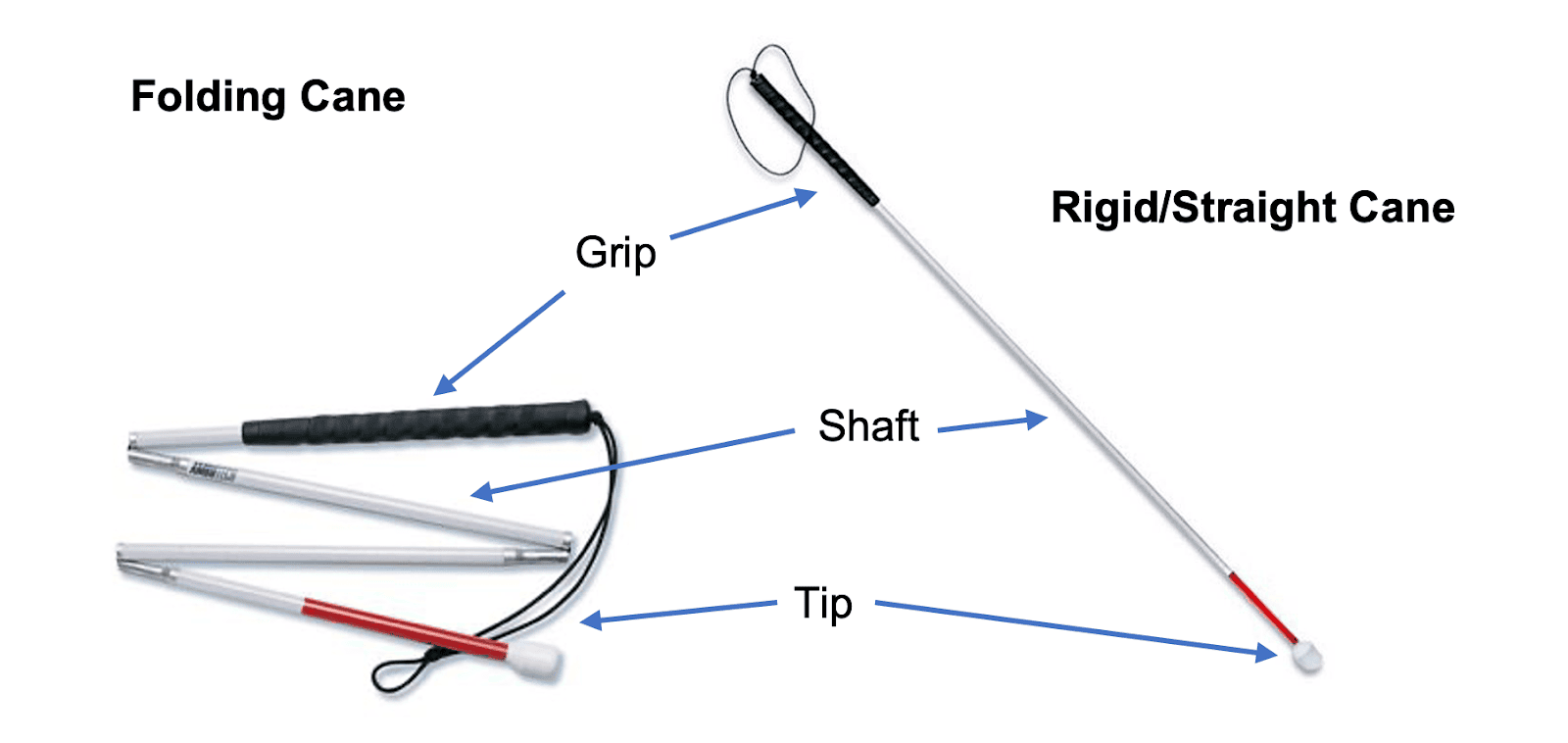
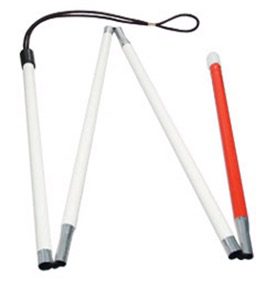
There are two main types of long cane: the rigid cane and the folding cane. The choice usually comes down to personal preference, with many preferring the folding cane for ease of storage.
There is also an ID cane and a support cane, both of which have different purposes for use.
The material canes are made from also varies. The standard cane is made from aluminium. However fibreglass, graphite, and carbon fibre canes are also available. Learn more about different cane types in our article on common kinds
Choosing a cane
There are several factors to consider when choosing the right long cane for low vision, including:
Length: The length of the cane should be chosen based on the user’s height and the environment in which it will be used. It is important to choose a cane that is the correct length, as a cane that is too long or too short can be difficult to use and may not provide the desired level of support.
Material: The material of the cane should be lightweight and durable, such as aluminium or fibreglass. This will make it easy to carry and manoeuvre, and will ensure that the cane will last for a long time.
Tip: The tip of the cane should be tapered and made of a material that can detect obstacles and changes in terrain, such as rubber or plastic. It is important to choose a tip that is durable and will not wear down over time.
Handle: The handle of the cane should be comfortable to hold and easy to grip, even in wet conditions. It is also important to choose a handle that is adjustable, so that the cane can be customised to fit the user’s needs and preferences.
Orientation and Mobility (O&M) Specialists are qualified to recommend which long cane is best suited to each individual.
What is the identification cane?
The identification or ID cane is mainly to provide identification to the public that the person using the cane has vision loss. They are typically a white cane with a red tip, and are often used in conjunction with other assistive devices such as a guide dog or electronic device.
The aid can assist with mobility by confirming the presence of drop-offs and other information perceived visually therefore helps increase a person’s confidence when travelling.
Limitations of the ID Cane:
Does not provide support
Does not give you information on what lies ahead on the surface
Cannot be used as a long cane due to its length, function and lack of strength.
Not always recognised as a vision impaired “tool” by the public.
As such, the ID cane is shorter than the traditional long cane, is lightweight and folds away easily for storage when not in use.
When is an ID cane used?
Generally, people who use an ID cane have some usable vision, but may encounter difficulties when travelling independently. These difficulties generally fall into the following areas:
Road crossings
Public transport
Crowds and congestion
As the name suggests, the ID cane alerts people that a person’s vision is limited, and this knowledge can be incredibly helpful to both the person with low vision and others.
Potential benefits of using an ID cane
Pedestrians may tend to clear the path of travel more readily;
Pedestrians may be more understanding if the person with low vision accidently bumps them;
Bus and tram drivers will more readily offer assistance when support is required to confirm the number of the bus that has pulled up, or to identify a destination;
People may be more understanding and helpful when the person with low vision needs to ask directions or requires support finding an item in a shop or they may step in and assist when there is an unexpected safety issue, such as a sign asking pedestrians to use the footpath on the opposite side of the road.
Identifying low vision at road crossings is also important to safety. A person with low vision will use other techniques, including choosing appropriate crossing locations and listening for traffic, in order to make safe road crossing decisions. Using an ID cane in conjunction with these techniques can maximise safety, by alerting drivers and cyclists to the person’s low vision and encouraging greater awareness and caution.
How do I use an ID cane?
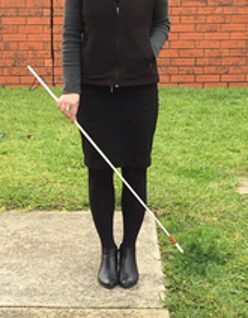
Unlike the long cane, the ID cane doesn’t touch the ground. It is designed to be held diagonally across the body, which maximises its prominence and visibility to others.
There is not a one size fits all ID cane. Different length ID canes are available to accommodate different heights. An Orientation and Mobility Specialist will advise the best size and will provide basic cane training on how to use it safely and effectively.