A white cane is a traditional mobility tool used by many people with low vision or blindness around the world. It can be a vital tool for people with low vision or blindness to navigate public spaces, giving them the ability to get around safely and independently. Typically made from lightweight materials like aluminium or carbon fibre, its white colour is important for a couple of reasons. Not only does it make the cane easy to spot, but it also lets others know that the person using it has a visual impairment, which can help them navigate congested areas more easily.
The cane is swept back and forth in front of the person using it to feel what’s ahead. Whether it’s a curb, a step or any other kind of obstacle, the cane helps them sense changes in the ground, like bumps or gaps, that are well ahead of their next step, making it easier to move through unfamiliar areas. It can also help them identify common features along a route they take every day.
The white cane has always been a symbol of independence, but recent innovations in its design have sought to make it even more effective and easier to use.
Emerging white cane technologies
Smart canes
While traditional canes continue to help those with low vision or blindness, people continue to try to innovate, with the introduction of smart canes giving people more choice.
Some small additions can make a big difference. Built-in flashlights are especially useful for low-light conditions, while rain-resistant technology has also become more common, protecting smart canes in various weather conditions. But it’s what is inside smart canes where things are getting interesting.
One of the most notable innovations is obstacle detection technology, where canes equipped with sensors can detect objects above waist level, an area that traditional canes can’t reach. Sensors alert the cane’s user through sound or vibrations, with the intensity of the signal increasing as they get closer to the obstacle.
The latest smart canes go even further, integrating artificial intelligence and GPS technology. Some models now pair with an app so people can save and explore locations either through their phone or through the cane. The cane or app alerts them to the distance to their destination, giving them spoken directions via the cane’s speaker. Some people may be fine with this feature, while others might want to avoid drawing attention to themselves with a device that makes audible announcements.
But what if you could have a conversation with your cane Smart canes can now feature Large Language Models (LLMs) connectivity, such as ChatGPT. This allows people to ask the cane questions and interact with it as they would with a smartphone, helping them do more than just navigate and explore spaces.
Of course, this type of tech isn’t for everyone.
One of the most important original features of the traditional cane is its provision of haptic feedback, or in other words the vibrations that the tactile feedback provides between the tip and surfaces. Some people prefer this organic interaction and a lightweight cane, rather than relying too heavily on electronic devices like obstacle detection.
It’s also important to consider the typically short life of a traditional white cane. Being such a tactile instrument, white canes experience wear and tear and require replacement. The risk of investing in smart cane technology might come down to needing to replace it too soon, so it’s important to consider how replaceable different elements of the cane might be.
Lightweight and adjustable materials
Any changes to the weight of a white cane put off many people, as over time this can add significant stress to wrist joints and fingers.
But the materials used in modern white canes have seen significant advancements. Today, manufacturers are using lightweight and adjustable materials such as carbon fibre and titanium, making the canes both sturdier and more comfortable, while some of the leaders in smart cane technology continue to improve the weight and handle design of their canes.
The type of white cane tip people opt for varies a lot. To avoid their tip getting caught on an object, which can be jarring and even painful, some opt for a rotating ball tip. Other tips are designed for outdoor use in bushland or grassland, while others are designed to optimise the auditory aspect of using a white cane.
Some tips can make the white cane heavier, which can impact wrist and arm movement. It’s important to choose a white cane tip based on how you want to use it, but also consider how it will impact the weight of the cane.
Object detection
There are other helpful devices you can use to detect objects, especially when you’re in a familiar environment like the office and you don’t want to use your cane.
One of the most common examples is the Miniguide. These are lightweight, handheld devices that can help people navigate their immediate environment, such as doorways, parked cars, and overhanging branches. This is similar to the technology that has been introduced into smart white canes, but you can keep it in your pocket when you’re not using it!
Learning how to use a white cane
The Orientation and Mobility service offered by Guide Dogs helps people with low vision or blindness learn how to move around safely and independently by using any remaining functional vision and other senses along with appropriate aides like mobility canes.
Orientation and Mobility Specialists work with individuals and their support people to teach many skills, including the ones necessary for making the most of a mobility cane. They work closely with individuals to teach them how to use white canes effectively, helping them adapt to different tip types and understand how to incorporate technology into their daily routines.
Using a long cane
Long canes are one of the most common tools that people with a vision impairment use to safely get around their community and stay safe on their feet.
Around 90% of people with low vision or blindness have some remaining vision. One significant benefit of a long cane is that it can be used to check for trip hazards on the ground (for example tree roots and broken pavers). It therefore enables a user to look up and ahead rather than down.
As we mention in the advice below, there is no single ‘correct’ way to use a long cane. There are, in fact, several ways and the one that’s right for you will be the method that makes you feel most comfortable and confident as you walk.
If you’re considering trying a long cane, it’s important that you seek professional advice and training from a Certified Orientation and Mobility Specialist. They can help you practise and develop your skills and techniques.
Choosing the right cane and cane tip
Canes are made from different materials and there are many different varieties of tips to attach to the end of a cane.
Choosing the cane and tip that suits you is important. In fact, it’s so important we’ve put together an entire article on cane materials, and another on cane tips.
Gripping the cane
You should hold the cane in your dominant hand, with the thumb and index finger positioned on either side of the handle. Keep your thumb on top (sometimes referred to as “thumb in the sun” position) and move the hand from the wrist rather than rolling it.
You should position the cane so that it makes contact with the ground ahead of each step, and there are a few ways to do that, which we mention below.
Scanning
One way of detecting obstacles and changes in terrain ahead of you while using a long cane is called scanning.
Scanning involves moving the cane from side to side in a sweeping motion, about 30 centimetres (one foot) in front of your leading shoe. You should touch the ground lightly with the cane as you scan.
You might find that a type of top known as a rolling tip is best suited to your cane if you prefer a constant contact method such as scanning.
Tapping the cane
An alternative to scanning is tapping. To do this, tap the tip of the cane on the ground about every second, listening for changes in sound that may indicate a change in terrain or the presence of an obstacle.
If you find that you prefer this method, you may also find that a pencil or pear tip is the best choice for your cane.
Learning to identify sounds
You can learn to identify sounds that indicate changes in the environment, such as the sound of a curb, the sound of a footpath, or the sound of a doorway.
If you have a particularly long cane, you can use it to amplify sound, and better identify otherwise difficult-to-hear sounds, by placing the handle of the cane against your ear.
Seeking help when necessary
If you’re unsure of your surroundings, it’s always a good idea to seek help from a trusted friend, family member, or sometimes even a stranger.
If, for example, you’re having trouble identifying a sound or surface, it can be helpful to ask someone nearby for assistance.
Using clues and landmarks
The cane is an excellent tool for determining changes in terrain, but it’s best used with a variety of other techniques, including the use of auditory clues and landmarks.
Clues might be visual (sight-related), auditory (sound-related) or olfactory (smell-related). Examples include the scent of a bakery, the sound of an air conditioner or the glow from a streetlight. They can be very handy in guiding you, but aren’t always reliable or constant. If the bakery is closed or the air conditioner is switched off, the clues are no longer available.
Landmarks, on the other hand, are always there, no matter the time of day. They include buildings, and streetscape fixtures such as letter boxes.
More information on using a long cane
If you’re interested in trying a long cane or learning the skills to get out and about safely on foot, contact a Certified Orientation and Mobility Specialist.
Our Orientation and Mobility Services can support you to get where you want to go with more confidence, ease, and safety.
Common types of tips you can attach to long canes
A cane tip is the rubber or ceramic part can be attached to the end of a long cane. It’s the part of the cane that comes into contact with the ground, and so is an essential component of the equipment, helping a person with low vision or blindness to detect obstacles and navigate their surroundings safely.
The type of tip used on a white cane can vary depending on the user’s needs and the environment they’re navigating. This article doesn’t recommend one type above another, but instead is an introduction to some of the common tips in Australia.
Before we start, we should mention that there are different brands of canes and cane tips. Again, this article isn’t attempting to rank or rate them. It is, however, important to keep in mind that a tip made by one manufacturer may not fit on a cane made by another.
The pencil tip
This is a small, very common tip that’s really lightweight. It gives you lots of feedback, helping you determine even small changes in the ground you’re travelling upon.
If there’s a downside to this tip, it’s that it can sometimes get caught on the surface you’re navigating. For that reason, if you’re using this tip you’ll want to use a lightweight feather touch. We often find that a person who prefers the two-point touch method (as opposed to constant contact) of cane use also prefers this kind of tip.
The pear tip and marshmallow tip
These tips are very similar to the pencil tip but are a little bit wider in the base, which is how they get their names. One looks like the fruit and the other looks a bit like the lolly.
Like the pencil tip, both of these tips are lightweight and will give plenty of feedback. But the pear and marshmallow tips are well-suited to both two-point touch and constant contact methods.
What’s the difference between these two tips Not a great deal–they’re different companies’ names for tips that serve essentially the same purpose as one another.
The ball race tip
This round tip, a little bit smaller than a golf ball, is designed to glide across the surface you’re travelling on, rotating as you move ahead.
Because it rotates, it tends to pick up a little bit less feedback than the pencil, marshmallow and pear tips. However, you may find that because it glides, it catches on the ground less than its lighter counterparts.
Some people find that maintaining a steady cane arc is more difficult with a ball race tip, simply because when you use a rotating tip, the cane tends to move a little bit further from left to right than it would with a fixed tip.
The rural tip
Similar in shape to the ball race tip, the rural tip is fixed; it doesn’t rotate as you use it.
Like the ball race tip, it provides less feedback than other tips, but is less likely to catch on any bumps you come across in your travels.
The Supaball rolling tip
The largest cane tip you can find is called the Supaball, and it’s produced by a company called Ambutech.
It’s almost the size of a tennis ball and is heavier than all the tips mentioned above. It also provides less feedback than some other tips, but is well-suited to travelling for longer distances, especially if the surface is relatively smooth.
The Bundu Basher
Another brand name, this tip is really unique. It’s thin, round-edged and shaped almost like a U. When you add it to the end of your cane it makes it look a little bit like a hockey stick.
It’s designed specifically for outdoor use, including bushland and heavy grassland, and its manufacturer recommends using it with a figure-eight method. It can be really useful in certain situations, but does require a bit of extra Orientation & Mobility Specialist training than would be the case with many of the tips mentioned above.
The ceramic cane tip
Another tip exclusive to Ambutech, the ceramic cane tip is shaped like a half a ball; the rounded half is the part that touches the ground.
It provides superior audio feedback from the environment with which it’s connecting. You’ll get unique sounds from different surfaces, helping you identify where you are and how the surface beneath you might have changed.
It’s small, so can get caught, but is well-suited to all cane use methods.
If you’d like help with cane techniques, you might find our article on tips for using a cane useful.
If you’d like some training or advice, you can get in contact with an Orientation & Mobility Specialist.
About this list
A long cane is a mobility aid that helps people with low vision or blindness to detect obstacles and hazards on the ground in front of them. The long cane is generally white in colour because white is an international symbol of vision impairment.
We’ve put together a list of some of the most common types of long canes.
It’s not exhaustive and, before you read on, it’s worth noting that the best type of cane for a person with low vision or blindness will depend on their specific needs, preferences, and level of mobility. It’s important to seek advice from an Orientation and Mobility Specialist to determine the best type of cane for each individual.
Aluminium cane
An aluminium cane is the most common type of long cane. Aluminium canes are lightweight (although not the lightest canes available), durable and often less expensive than canes made from other materials. Aluminium also allows for easy customisation.
Composite fibre cane
A composite fibre cane is generally made from fibreglass and resin. Many composite fibre canes are lighter than aluminium canes and offer greater sensitivity in detecting surface irregularities. They are also more durable than aluminium canes and are less likely to bend or break.
Carbon fibre cane
A carbon fibre cane is made of extremely thin strands of carbon, which are tightly woven together to form a fabric-like material. This is the lightest common material used for making canes and is exceptionally strong while remaining highly sensitive.
There are many devices, tools and aids available to make your life easier. If you need help finding the right ones for you, take a look at our Assistive Technology resources.
What Are Support Canes?
Support canes are specialised canes that are designed to provide additional support, stability, and safety for individuals who are visually impaired. Support canes typically feature a wider base than traditional canes, which provides additional stability and balance. They are often adjustable in height, so users can find the perfect height to meet their needs. The canes are usually made from lightweight, durable materials, such as aluminium or carbon fibre, and they feature ergonomic handles for a comfortable grip and reduced fatigue during extended use.
The Benefits of Using a Support Cane
Support canes can offer a range of benefits for those who are visually impaired, including:
Increased independence: Support canes provide users with additional stability and support, which can make it easier to navigate unfamiliar environments and increase independence.
Reduced fatigue: The ergonomic handles on support canes are designed to reduce fatigue, even during extended use, making it easier for users to complete daily tasks.
Enhanced mobility: Support canes provide users with additional stability and support, which can make it easier to move around, even on uneven surfaces or in challenging environments.
Overall, support canes are a valuable tool that can help improve quality of life and increase independence for those who are visually impaired. Whether you are just starting to navigate with a cane or are looking for a more advanced solution, a support cane can be a great option to consider.
Suitability will vary depending on the individual and their specific needs and abilities. When determining the best cane, it’s important consult with a qualified an Orientation & Mobility specialist.
What is the long cane?
The long cane/white cane is a primary mobility aid that can increase the independence of a person who is blind or has low vision. It can be used by adults and children. The white can may also be known as a mobility cane.
Using a long cane has many functions including:
Acting as a bumper, detecting obstacles up to waist height in front of the traveller
Detecting drop-offs such as stairs and kerbs
Identifying changes in texture which can help the user keep track of where they are on their travel route
Being used as a probe to explore nearby surrounds
Allowing the user to focus on their residual vision or other senses instead of concentrating on where their foot is placed next
Identifying the user as having low vision or blindness, which can increase their safety – this can be especially useful in congested areas, when using public transport and when crossing roads
Helping increase confidence and the ability of the user to travel independently.
How do I use a white cane?
As with any skill, specialised training is required to use the long cane safely and effectively. Training to use the white cane will be with an Orientation and Mobility (O&M) Specialist. They will not only introduce the skills required to use the cane, but will also focus on teaching relevant orientation skills and safe routes of travel.
Types of white canes
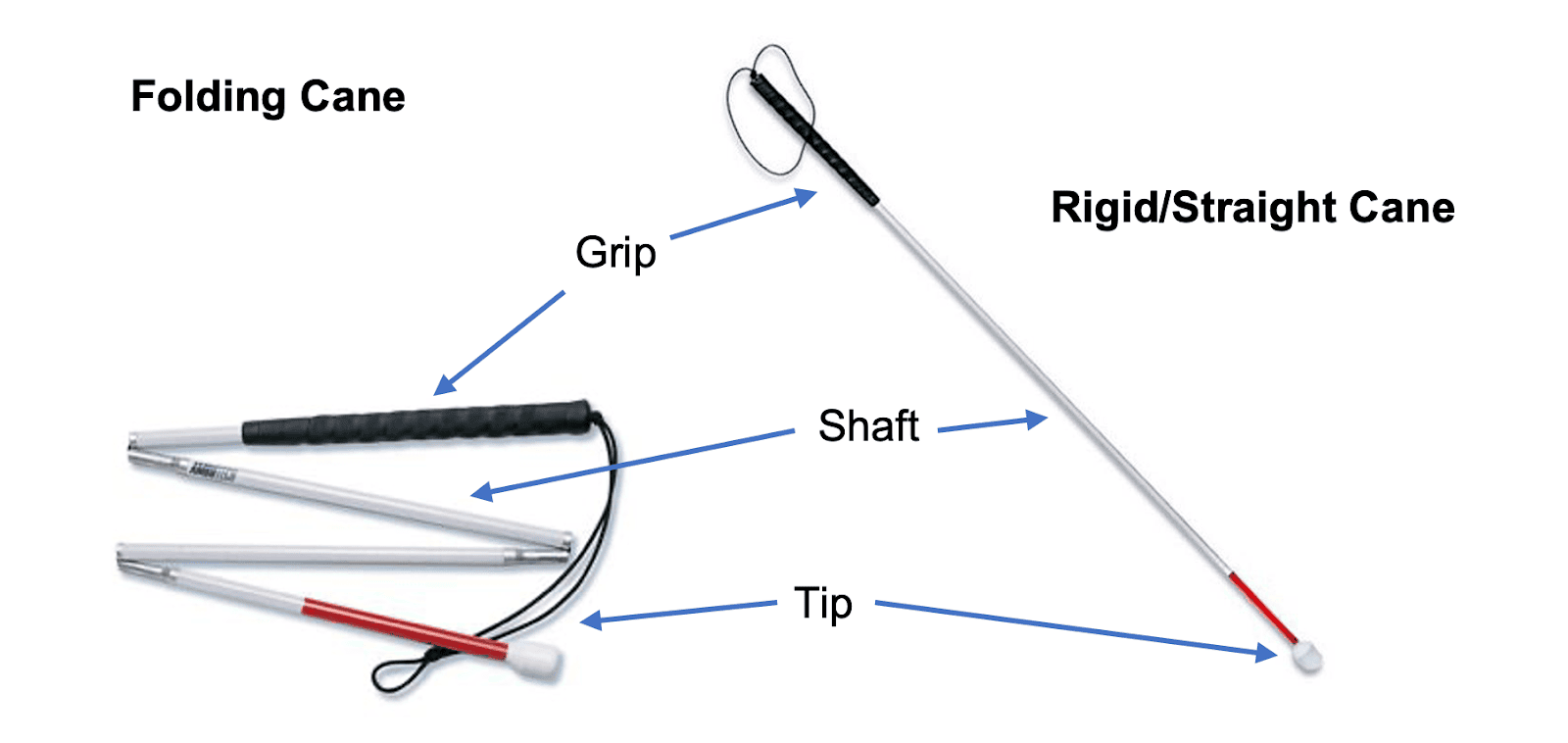
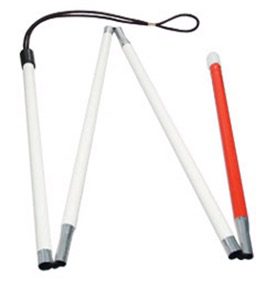
There are two main types of long cane: the rigid cane and the folding cane. The choice usually comes down to personal preference, with many preferring the folding cane for ease of storage.
There is also an ID cane and a support cane, both of which have different purposes for use.
The material canes are made from also varies. The standard cane is made from aluminium. However fibreglass, graphite, and carbon fibre canes are also available. Learn more about different cane types in our article on common kinds
Choosing a cane
There are several factors to consider when choosing the right long cane for low vision, including:
Length: The length of the cane should be chosen based on the user’s height and the environment in which it will be used. It is important to choose a cane that is the correct length, as a cane that is too long or too short can be difficult to use and may not provide the desired level of support.
Material: The material of the cane should be lightweight and durable, such as aluminium or fibreglass. This will make it easy to carry and manoeuvre, and will ensure that the cane will last for a long time.
Tip: The tip of the cane should be tapered and made of a material that can detect obstacles and changes in terrain, such as rubber or plastic. It is important to choose a tip that is durable and will not wear down over time.
Handle: The handle of the cane should be comfortable to hold and easy to grip, even in wet conditions. It is also important to choose a handle that is adjustable, so that the cane can be customised to fit the user’s needs and preferences.
Orientation and Mobility (O&M) Specialists are qualified to recommend which long cane is best suited to each individual.
What is the identification cane?
The identification or ID cane is mainly to provide identification to the public that the person using the cane has vision loss. They are typically a white cane with a red tip, and are often used in conjunction with other assistive devices such as a guide dog or electronic device.
The aid can assist with mobility by confirming the presence of drop-offs and other information perceived visually therefore helps increase a person’s confidence when travelling.
Limitations of the ID Cane:
Does not provide support
Does not give you information on what lies ahead on the surface
Cannot be used as a long cane due to its length, function and lack of strength.
Not always recognised as a vision impaired “tool” by the public.
As such, the ID cane is shorter than the traditional long cane, is lightweight and folds away easily for storage when not in use.
When is an ID cane used?
Generally, people who use an ID cane have some usable vision, but may encounter difficulties when travelling independently. These difficulties generally fall into the following areas:
Road crossings
Public transport
Crowds and congestion
As the name suggests, the ID cane alerts people that a person’s vision is limited, and this knowledge can be incredibly helpful to both the person with low vision and others.
Potential benefits of using an ID cane
Pedestrians may tend to clear the path of travel more readily;
Pedestrians may be more understanding if the person with low vision accidently bumps them;
Bus and tram drivers will more readily offer assistance when support is required to confirm the number of the bus that has pulled up, or to identify a destination;
People may be more understanding and helpful when the person with low vision needs to ask directions or requires support finding an item in a shop or they may step in and assist when there is an unexpected safety issue, such as a sign asking pedestrians to use the footpath on the opposite side of the road.
Identifying low vision at road crossings is also important to safety. A person with low vision will use other techniques, including choosing appropriate crossing locations and listening for traffic, in order to make safe road crossing decisions. Using an ID cane in conjunction with these techniques can maximise safety, by alerting drivers and cyclists to the person’s low vision and encouraging greater awareness and caution.
How do I use an ID cane?
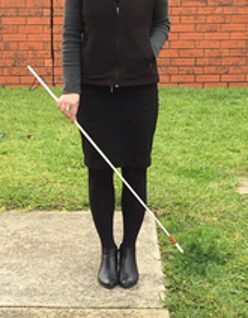
Unlike the long cane, the ID cane doesn’t touch the ground. It is designed to be held diagonally across the body, which maximises its prominence and visibility to others.
There is not a one size fits all ID cane. Different length ID canes are available to accommodate different heights. An Orientation and Mobility Specialist will advise the best size and will provide basic cane training on how to use it safely and effectively.